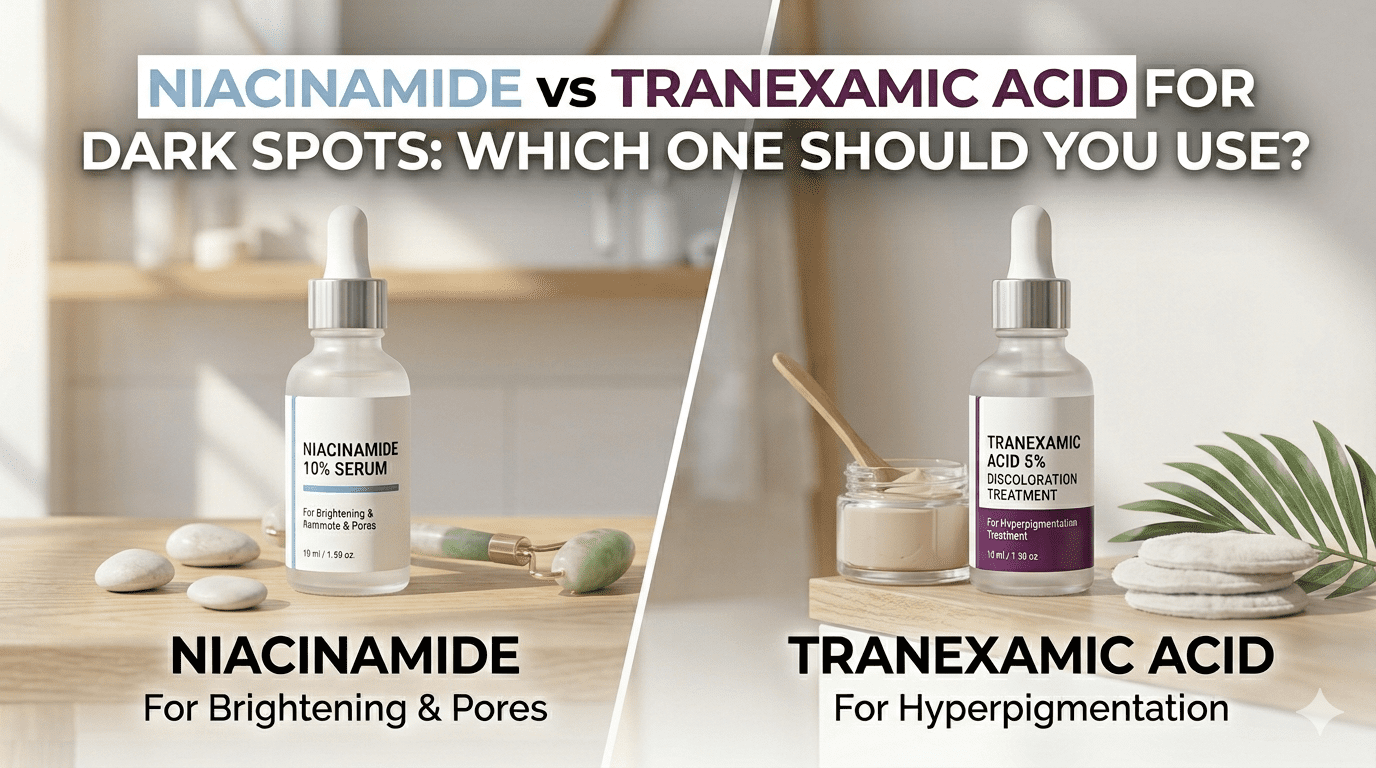
Niacinamide and tranexamic acid are two of the most frequently recommended ingredients for dark spots and uneven skin tone. Both have solid clinical evidence. Both are well-tolerated across skin types. And crucially, both work through completely different mechanisms, which means they are more valuable together than in competition.
Knowing which one to prioritise depends on what is causing your dark spots, not just what the spots look like.
How Niacinamide and Tranexamic Acid Work on Dark Spots
Pigmentation becomes visible when melanin, produced by melanocytes in the base layer of the skin, concentrates in patches and transfers into the surface skin cells where it becomes visible as a dark spot.
Niacinamide targets the transfer stage. It does not stop melanin from being produced. A landmark 2002 study in the British Journal of Dermatology confirmed this directly: niacinamide had no effect on melanin production in isolated cell cultures, but produced 35 to 68% inhibition of melanin transfer from melanocytes into the surrounding skin cells in co-culture models. The clinical result was significant reduction in visible hyperpigmentation after four weeks at 5%. In simple terms: niacinamide reduces how much of the melanin that gets made actually reaches the surface.
Tranexamic acid works at an earlier, different stage. It targets the signalling pathway that triggers melanin overproduction in the first place. When the skin is exposed to UV radiation or inflammation, a protein called plasminogen is activated in keratinocytes. Activated plasminogen triggers a cascade of chemical signals, including prostaglandins and other inflammatory mediators, that tell melanocytes to produce more melanin. Tranexamic acid blocks plasminogen activation, effectively cutting off the chemical instruction before it reaches the melanocyte. It is not a tyrosinase inhibitor. It works upstream of melanin synthesis entirely.
This means the two ingredients address dark spots at two completely separate points: tranexamic acid reduces the trigger for melanin overproduction, niacinamide reduces how much of any melanin that is produced reaches the surface. Used together, the brightening effect is additive and more comprehensive than either delivers alone.
What Niacinamide Does Best for Dark Spots
Niacinamide’s mechanism makes it particularly effective for post-inflammatory hyperpigmentation, the flat dark marks left behind after acne, eczema flares, or skin injuries. These spots form because inflammation triggers excess melanin production which then transfers into surface skin cells. Niacinamide’s transfer-blocking action directly addresses the second half of this process.
Beyond brightening, niacinamide is one of the most genuinely multi-functional skincare ingredients available:
It strengthens the skin barrier by boosting ceramide and fatty acid production. A stronger barrier reduces the low-grade inflammation that continually restimulates melanocyte activity, which is why niacinamide improves tone even in skin that is not actively breaking out.
It suppresses inflammatory cytokines including interleukin-8, reducing the skin’s inflammatory response to acne-causing bacteria and UV exposure. Less inflammation means fewer PIH triggers.
It regulates sebum production, which for oily and acne-prone skin reduces the congestion that leads to more breakouts and more PIH.
It is non-irritating, stable in formulation, compatible with almost every other skincare ingredient, and can be used morning and evening from day one with no adjustment period. This tolerability is what makes it so useful as a daily staple for anyone managing recurring dark marks.
Best concentration: 2 to 5% for brightening and barrier support. Products at 10% are widely available and well tolerated. The clinical evidence for meaningfully better brightening results above 5% is limited, but the higher concentration is useful for sebum regulation and pore minimisation.
What Tranexamic Acid Does Best for Dark Spots
Tranexamic acid’s defining strength is treating stubborn, deeply rooted, or recurring pigmentation where the trigger is ongoing, specifically melasma and chronic UV-driven hyperpigmentation.
For melasma in particular, tranexamic acid has the most compelling clinical evidence of any non-prescription brightening ingredient. Melasma is driven by a combination of hormonal influence and UV exposure that continually activates melanocytes through the plasminogen pathway. Multiple clinical trials have demonstrated topical tranexamic acid at 2 to 5% producing significant improvement in melasma severity scores. A 2025 randomised double-blind clinical trial published in Scientific Reports found that tranexamic acid combined with niacinamide produced comparable results to 4% hydroquinone in melasma patients, with a more favourable safety profile and lower irritation scores.
A 12-week clinical study on a serum containing 3% tranexamic acid, 1% kojic acid, and 5% niacinamide reported an average 81% reduction in PIH and 60% improvement in melasma across participants, demonstrating what the combination of tranexamic acid and niacinamide achieves when working together.
Tranexamic acid is also effective for UV-induced pigmentation and the kind of uneven tone that accumulates over years of sun exposure, because UV radiation is one of the primary activators of the plasminogen pathway it blocks.
It does not cause irritation, does not increase photosensitivity, and is suitable for daily use across all skin types and tones. For skin of colour in particular, this safety profile is important because irritation itself triggers the PIH that makes dark spots worse.
Best concentration in leave-on products: 2 to 5%.
Niacinamide vs Tranexamic Acid: Which Is Better for Your Skin Concern?
Melasma: Tranexamic acid is the stronger primary ingredient. Its mechanism addresses the hormonal and UV signalling triggers that drive melasma at the source. Niacinamide is highly effective alongside it as a complementary active, and the clinical evidence for their combination is excellent.
Post-acne dark marks and PIH: Both are effective. Niacinamide’s barrier-strengthening and anti-inflammatory properties make it particularly valuable here because it reduces the ongoing inflammation that keeps triggering new PIH. Tranexamic acid’s anti-inflammatory plasminogen blocking adds further reinforcement. Using both together gives the most complete result.
Sun spots and UV-induced pigmentation: Tranexamic acid is the more targeted choice, since UV exposure is a direct activator of the plasminogen pathway it blocks. Niacinamide helps by reducing how much of the resulting melanin reaches the surface.
Oily, acne-prone, or congested skin: Niacinamide is the better primary active. Its sebum regulation, pore minimisation, and anti-inflammatory effects address the skin concerns that drive recurring breakouts and PIH, none of which tranexamic acid targets.
Sensitive or reactive skin: Both are non-irritating and suitable. Neither requires an adjustment period or causes photosensitivity. Niacinamide’s barrier-building effect makes it additionally useful for reactive skin that is dealing with ongoing inflammation.
Darker skin tones (Fitzpatrick IV to VI): Both are appropriate. Neither ingredient carries irritation risk, which is the key consideration for skin types more prone to PIH from sensitisation. The combination is one of the most widely recommended approaches for pigmentation in skin of colour precisely because of this safety profile.
Stubborn pigmentation that has not responded to other brightening actives: Tranexamic acid. Its unique mechanism is distinct from tyrosinase inhibitors and melanin-transfer blockers, which means it can address pigmentation that those approaches have not resolved.
Can You Use Niacinamide and Tranexamic Acid Together?
Yes, and the clinical evidence for their combination is particularly strong.
Because they work at different stages of the pigmentation process, they complement each other rather than overlap. Tranexamic acid reduces the signal that causes melanin overproduction. Niacinamide reduces how much of any melanin produced reaches the surface. At the same time, niacinamide’s barrier-strengthening and anti-inflammatory benefits reduce the chronic low-grade inflammation that makes hyperpigmentation recurring rather than isolated.
An eight-week double-blind vehicle-controlled study of 42 Korean women found that a topical formulation combining 2% niacinamide with 2% tranexamic acid was significantly more effective at lightening facial hyperpigmentation than vehicle alone. The 2025 Scientific Reports trial on niosomal and conventional tranexamic acid plus niacinamide versus hydroquinone found comparable efficacy with a better safety profile. Both studies reflect what practitioners are increasingly seeing in clinical practice: this combination outperforms either ingredient used alone, and approaches the efficacy of prescription-strength hydroquinone without the associated risks.
How to layer them in a routine: Both are water-based, stable ingredients that can be applied in the same step or in sequence. Apply tranexamic acid or a combined serum to clean skin, follow with other targeted actives if needed, then moisturiser and SPF in the morning. There are no adverse interactions between the two ingredients. Adding niacinamide in the morning and evening while using tranexamic acid once daily is a practical and evidence-backed approach.
The Role of SPF in a Niacinamide and Tranexamic Acid Routine
SPF determines whether either ingredient’s results are visible over time.
UV exposure directly activates the plasminogen pathway that tranexamic acid is blocking, and it stimulates melanin production that niacinamide is trying to contain at the transfer stage. Unprotected sun exposure each day partially reverses the progress both ingredients are making. Broad spectrum SPF 50 applied every morning is not optional when using either ingredient, or any brightening active.
How to Read Product Labels for Both Ingredients
Niacinamide is listed as niacinamide or nicotinamide. Look for it near the top of the ingredient list at a stated concentration. Many reputable brands now disclose the percentage. For brightening specifically, products stating 5% are the most directly supported by clinical evidence. Products where niacinamide appears near the end of a long ingredient list are likely underdosed.
Tranexamic acid is listed as tranexamic acid. Effective leave-on concentrations for brightening are 2 to 5%. It appears in toners, serums, and treatment creams. Products at below 2% may not contain enough active ingredient to produce measurable brightening results. Unlike some ingredients that require specific pH or packaging for stability, tranexamic acid is generally stable across standard formulation conditions.
Frequently Asked Questions
Which is better for dark spots: niacinamide or tranexamic acid? For melasma and sun-driven pigmentation, tranexamic acid is the stronger primary choice. For PIH from acne and general barrier-supported brightening, niacinamide is more directly suited. For most people dealing with multiple types of dark spots, using both together gives the most complete result.
Can niacinamide and tranexamic acid be used in the same routine? Yes, and the clinical evidence specifically supports this combination. A 2025 randomised trial found the combination comparable to 4% hydroquinone for melasma with fewer side effects. They work at different stages of the pigmentation pathway and are fully compatible.
Is tranexamic acid better than niacinamide for melasma? Tranexamic acid has more targeted evidence for melasma specifically. Niacinamide is highly effective alongside it. The combination of both, supported by daily SPF, is the most evidence-backed topical approach to melasma without a prescription.
How long does it take to see results from each ingredient? Niacinamide typically shows visible improvement in dark spots from eight to twelve weeks of consistent use. Tranexamic acid for melasma and stubborn pigmentation also typically takes eight to twelve weeks, though some studies show measurable improvement from six weeks. Both require consistent daily use and daily SPF for results to be visible.
Is niacinamide or tranexamic acid better for oily skin? Niacinamide is better suited for oily skin. It regulates sebum production, minimises pore appearance, and reduces the inflammatory acne that causes the PIH dark spots that oily skin commonly deals with. Tranexamic acid does not address sebum or oil control.
The Bottom Line: Niacinamide vs Tranexamic Acid for Dark Spots
Niacinamide is the more versatile daily brightening active. It blocks melanin transfer at the delivery stage, strengthens the barrier, reduces inflammation, and regulates sebum, making it useful for practically every skin type and a particularly important ingredient for anyone dealing with recurring PIH from acne.
Tranexamic acid is the more targeted intervention for stubborn and deeply rooted pigmentation. Its unique plasminogen-blocking mechanism addresses the upstream trigger for melanin overproduction, making it the strongest topical option for melasma and chronic UV-driven pigmentation that has not responded well to other brightening approaches.
The most effective dark spot routine uses both: tranexamic acid to reduce the signal that causes overproduction, niacinamide to reduce how much of any melanin produced reaches the surface, and daily SPF to prevent UV from reactivating both processes daily.