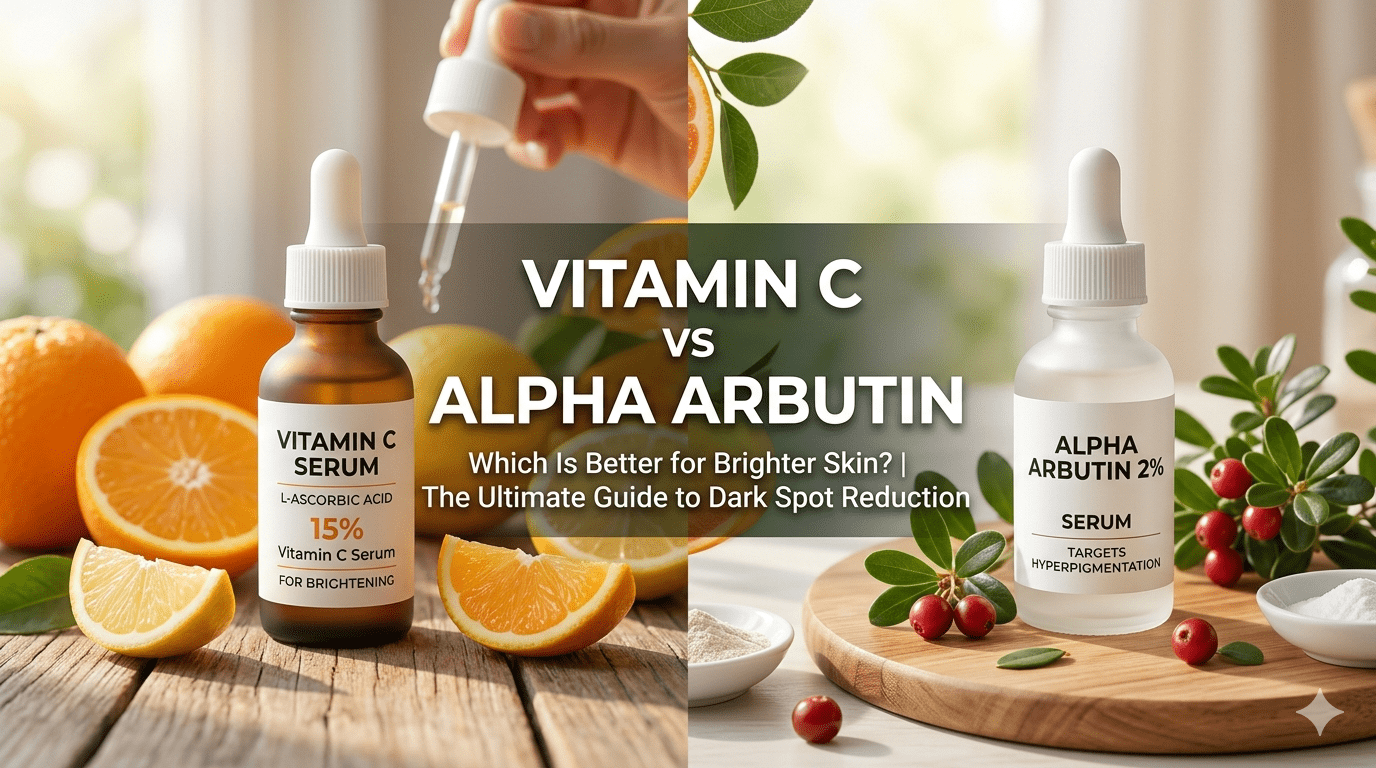
Both are brightening staples. Both show up in serums targeting dark spots and uneven tone. Both work by slowing down melanin production, just through different mechanisms, at different speeds, with different tolerability profiles.
The real question is not which one is better in isolation. It is which one is better for your specific type of pigmentation, and whether your skin can handle both at the same time.
How Vitamin C and Alpha Arbutin Brighten Skin
Melanin, the pigment responsible for skin colour, is produced by cells called melanocytes. An enzyme called tyrosinase controls how much gets made. Most effective brightening ingredients interfere with tyrosinase in some way.
Vitamin C does this and more. It inhibits tyrosinase, reducing how much melanin gets produced. It also neutralises the free radicals generated by UV exposure and pollution that trigger melanin overproduction before the production process even begins. This makes it both preventive and corrective. On top of that, it stimulates collagen, which is why it is one of the few brightening ingredients that also visibly improves skin firmness and texture over time.
Alpha arbutin works more precisely. It is a derivative of hydroquinone, the gold-standard prescription brightener, but with a glucose molecule attached that controls how it is released onto the skin. This makes it significantly gentler and safer than hydroquinone itself, while still blocking the same tyrosinase enzyme. It does not have vitamin C’s antioxidant or collagen benefits, but what it does, it does reliably and without irritation.
The meaningful difference: vitamin C has a broader range of skin benefits but comes with formulation and tolerability challenges. Alpha arbutin is narrower in scope but more consistent, more stable, and safer for daily use across all skin types.
What Vitamin C Does for Uneven Skin Tone
Vitamin C’s antioxidant action makes it particularly effective for pigmentation driven by UV and environmental damage, including sun spots, general dullness from years of unprotected sun exposure, and the kind of uneven tone that accumulates gradually. Rather than just fading what is already there, it helps prevent new pigmentation from forming in response to daily oxidative stress.
The collagen benefit is also real. Used consistently, vitamin C improves skin texture and firmness alongside brightening. No other common brightening ingredient does this, which is why it earns its place in most morning routines.
The formulation challenge. L-ascorbic acid, the most potent form of vitamin C, degrades quickly when exposed to air, heat, and light. Once it oxidises, it turns orange or brown and actually works against the skin rather than for it. A high-quality serum in opaque, airtight packaging makes a meaningful difference to how much active ingredient reaches your skin. If L-ascorbic acid causes tingling or your serum keeps oxidising before you finish the bottle, stable derivatives like sodium ascorbyl phosphate or tetrahexyldecyl ascorbate are solid alternatives. They convert to active vitamin C after skin absorption, with better shelf life and lower irritation risk.
Best concentration for brightening: 10 to 20% for L-ascorbic acid. Derivatives are typically formulated at 3 to 10%.
What Alpha Arbutin Does for Dark Spots and Hyperpigmentation
Alpha arbutin is one of the most targeted and reliable brightening ingredients available without a prescription. It blocks tyrosinase directly, slowing melanin production in the areas where it has become overactive: the patches that show up as dark spots, post-acne marks, and uneven tone.
What makes it stand out is what it does not do. It does not irritate. It does not cause photosensitivity. It does not need special storage or degrade in the bottle. And unlike hydroquinone, it does not carry the risk of rebound darkening with extended use. The EU Scientific Committee on Consumer Safety considers it safe for daily use at up to 2% in face products, and that 1 to 2% range is where effective consumer products sit.
This combination of gentleness and reliability makes alpha arbutin particularly well-suited to post-inflammatory hyperpigmentation (PIH), the dark marks left behind by acne, eczema flares, or skin injuries. These spots are caused by inflammation triggering excess melanin production. Alpha arbutin’s steady, non-irritating approach addresses this without adding any new inflammatory stimulus to already-sensitised skin. For skin tones that are more prone to PIH, generally Fitzpatrick III to VI, this matters a great deal. Any ingredient that stings or irritates on reactive skin risks triggering more pigmentation, which is exactly what alpha arbutin avoids.
Best concentration: 1 to 2%. Results plateau above this range, and the EU safety approval covers only this concentration for face products. More is not better here.
A note on forms: Products that list just “arbutin” without specifying the type are often using beta arbutin, which is less stable and less effective than the alpha form. Alpha arbutin is the clinically supported option. Check the label before buying.
Vitamin C vs Alpha Arbutin: Which One Is Right for Your Skin?
| Skin Concern | Better Choice |
|---|---|
| Sun spots and UV-induced pigmentation | Vitamin C |
| Post-acne dark marks and PIH | Alpha arbutin |
| Overall dullness and lack of glow | Vitamin C |
| Sensitive or reactive skin | Alpha arbutin |
| Darker skin tones (Fitzpatrick IV to VI) | Alpha arbutin as primary active |
| Anti-aging benefits alongside brightening | Vitamin C |
| Melasma | Both, with daily SPF. Neither alone is sufficient |
| Stable year-round use in humid climates | Alpha arbutin |
Can You Use Vitamin C and Alpha Arbutin Together?
Yes, and combining them is more effective than choosing one.
Vitamin C reduces melanin production by blocking tyrosinase and neutralising UV-triggered oxidative stress. Alpha arbutin blocks tyrosinase through a different, more direct binding mechanism. These approaches are additive: they cover more of the brightening pathway together than either does alone, with no adverse interaction between them.
The most practical approach is vitamin C in the morning, where its antioxidant protection is most useful against daytime UV and pollution, and alpha arbutin morning or evening. If layering both in the same routine, apply vitamin C first. It penetrates best on clean skin before other products alter the surface. Then apply alpha arbutin once the vitamin C has absorbed.
One step makes everything else work: SPF. Both ingredients reduce melanin production. UV exposure restimulates it. Every unprotected day in the sun partially reverses what both ingredients are doing. Broad spectrum SPF 50 every morning is not optional in any brightening routine.
How Long Does It Take to See Results from Vitamin C and Alpha Arbutin?
Neither ingredient delivers fast results, and most people judge a brightening product too early.
Vitamin C tends to improve overall glow within four to six weeks, largely from its antioxidant effect restoring baseline skin radiance. Targeted spot reduction from either ingredient typically requires eight to twelve weeks of consistent daily use.
Melasma responds more slowly, often taking four to six months, and tends to recur without ongoing UV protection. Both ingredients can help manage melasma as part of a broader routine, but neither is sufficient as a standalone treatment for established hormonal pigmentation.
Frequently Asked Questions
Which is better for dark spots: vitamin C or alpha arbutin? It depends on the cause. Vitamin C is better for UV-induced sun spots and general dullness. Alpha arbutin is better for post-acne marks and post-inflammatory hyperpigmentation. For most people dealing with both concerns, using them together produces the best results.
Which fades hyperpigmentation faster? Vitamin C tends to show visible brightening sooner because its antioxidant action improves overall radiance quickly. For targeted spot reduction, both typically show meaningful results around the eight to twelve week mark with consistent use.
Is alpha arbutin better than vitamin C for darker skin tones? Generally yes, as the primary brightening active. Higher Fitzpatrick skin types are more prone to PIH triggered by irritation, and alpha arbutin’s non-irritating mechanism avoids this risk entirely. Vitamin C at moderate concentrations or as a stable derivative can be used alongside it, but should be patch-tested first.
Does alpha arbutin work as well as hydroquinone? It works through the same pathway but more gently, and is safe for long-term daily use. Hydroquinone is faster and stronger but carries risks including rebound pigmentation and, with prolonged high-concentration use, ochronosis. Alpha arbutin is the recommended ongoing maintenance option. Hydroquinone is a short-term, prescription-strength intervention for severe pigmentation.
Is alpha arbutin safe during pregnancy? Alpha arbutin is generally considered one of the safer brightening options during pregnancy compared to hydroquinone, retinoids, or high-concentration vitamin C. That said, consult a healthcare provider before introducing any active skincare ingredient while pregnant.
The Bottom Line: Vitamin C vs Alpha Arbutin
Vitamin C is the broader-acting ingredient. Its antioxidant protection, collagen stimulation, and melanin inhibition make it the first choice for sun damage, overall glow, and skin quality improvement. The trade-off is formulation sensitivity and occasional irritation that needs to be managed through product selection.
Alpha arbutin is the more precise, dependable dark spot corrector. Targeted melanin inhibition, no irritation, no photosensitivity, no stability issues, and no risk of worsening pigmentation make it the safer primary choice for PIH, sensitive skin, and darker skin tones.
The most effective brightening routine uses both, applies them in the right order, and relies on daily SPF to do the work that neither ingredient can do on its own.