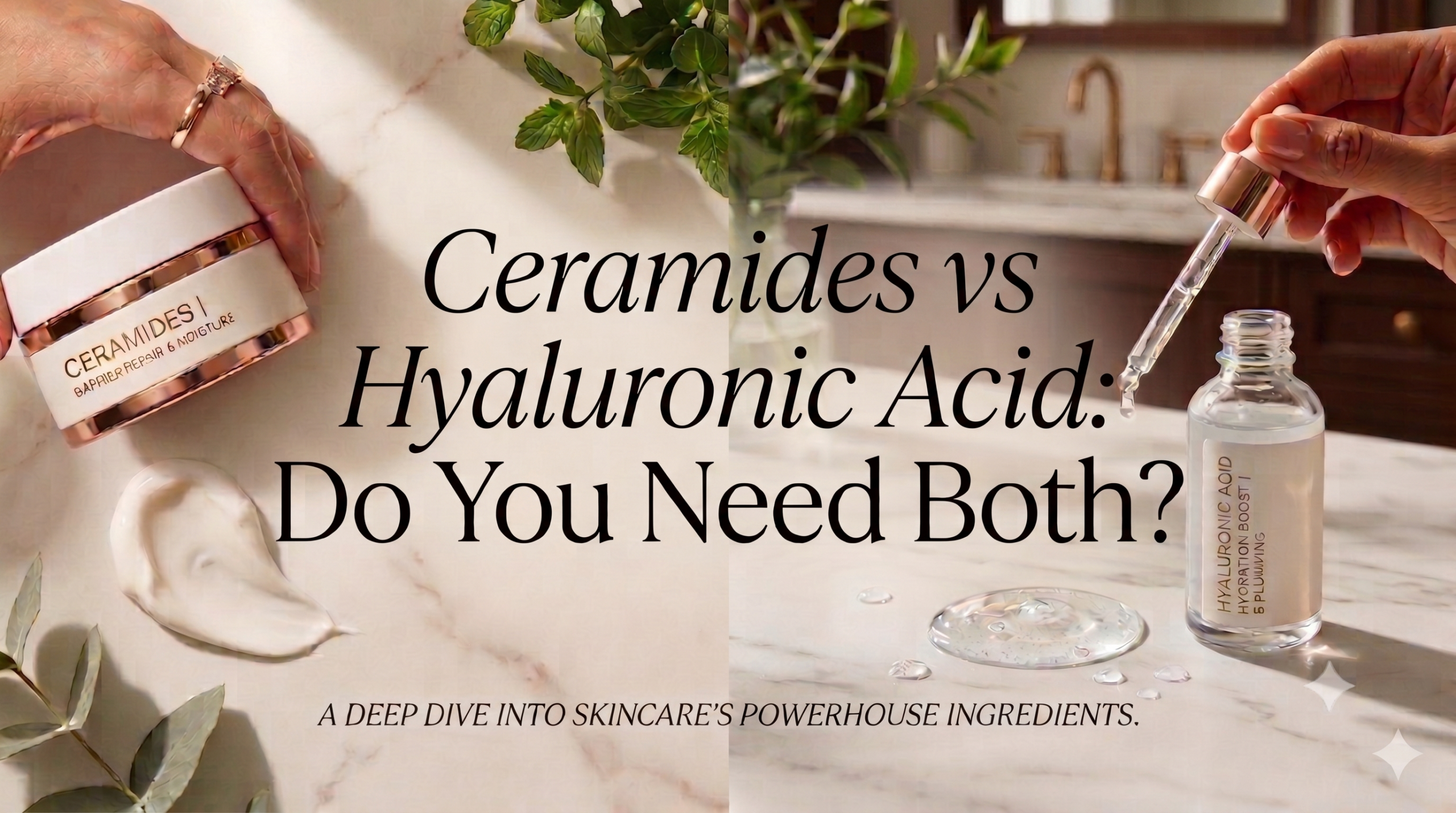
Two ingredients come up more than almost any others in serious skincare conversations: ceramides and hyaluronic acid. Both are staples recommended by dermatologists. Both appear in moisturisers, serums, and barrier repair products across every price point. Both are associated with hydration and skin health.
But they don’t do the same thing. Understanding the distinction between them, and why that distinction matters, is one of the most practically useful things you can learn about skincare.
The short answer to whether you need both: for most people, yes. But the reason why tells you a lot about how skin hydration actually works.
The Core Difference: Water In vs Water Staying In
The clearest way to understand ceramides and hyaluronic acid is through a single analogy.
Hyaluronic acid is water flowing into a glass. Ceramides are the lid that keeps it from evaporating.
Hyaluronic acid is a humectant. Its job is to attract water and draw it into the skin. It does this exceptionally well, binding up to 1,000 times its weight in water and delivering an immediate, visible plumping effect.
Ceramides are barrier lipids. Their job is to maintain the structural integrity of the outermost skin layer so that the water drawn in by humectants, and the water already present in the skin, doesn’t escape. They don’t add water. They ensure the water stays where it belongs.
One ingredient governs how much water gets in. The other governs how much stays. That’s why the two ingredients are complementary by design, and why relying on one without the other often produces underwhelming results.
What Is Hyaluronic Acid?
Hyaluronic acid (HA) is a naturally occurring sugar molecule (glycosaminoglycan) found in the skin, connective tissue, joints, and eyes. In skin specifically, it sits in the extracellular matrix of the dermis and epidermis, where it maintains hydration and gives tissue its plump, elastic quality.
As skin ages, natural HA levels decline, contributing to the thinner, drier, less resilient appearance associated with ageing. Topical HA supplements this by drawing moisture from the environment and from deeper skin layers into the upper epidermis, producing a rapid improvement in hydration levels and surface smoothness.
What Hyaluronic Acid Does
- Draws moisture into the upper layers of the skin (humectant action)
- Creates an immediate plumping and smoothing effect on the skin’s surface
- Reduces the appearance of fine lines caused by dehydration
- Improves skin elasticity temporarily through water retention
- Is well tolerated across all skin types, including oily and acne-prone skin
- Works at the surface and, in low molecular weight forms, deeper into the epidermis
What Hyaluronic Acid Doesn’t Do
- Repair or rebuild the skin barrier’s lipid structure
- Prevent water from evaporating out of the skin on its own
- Address the root cause of dryness when barrier function is compromised
- Provide structural support to skin that is losing lipids through age, over-exfoliation, or environmental stress
This limitation is important. If your skin barrier is weakened, hyaluronic acid applied topically can actually draw water from deeper skin layers toward the surface, where it then evaporates. Skin ends up feeling tighter and drier after application than before, particularly in dry or air-conditioned environments. This is why applying HA to damp skin and following with a moisturiser or occlusive is so consistently recommended; without a sealant layer, the benefits are temporary and, in some cases, counterproductive.
What Are Ceramides?
Ceramides are a family of lipid (fat) molecules that make up approximately 50% of the skin’s lipid matrix in the outermost layer, the stratum corneum. Along with cholesterol and free fatty acids, they form the “mortar” in the brick-and-mortar model of skin structure: the continuous lipid layer that holds skin cells together, prevents water from leaving the skin, and blocks irritants, allergens, and pathogens from getting in.
Ceramides are not a single compound. The stratum corneum contains multiple distinct ceramide classes, each with different structural properties and specific roles in barrier function. In skincare, this is why products formulated with a blend of ceramides (often listed as Ceramide NP, Ceramide AP, Ceramide EOP, or identified by numbers such as Ceramide 1, Ceramide 3, Ceramide 6-II) are generally more effective than those containing only one ceramide type. Multiple ceramide species working together more closely replicate the barrier’s natural composition.
What Ceramides Do
- Maintain the structural integrity of the skin barrier by replenishing its lipid matrix
- Reduce transepidermal water loss (TEWL), the passive evaporation of water through the skin
- Protect against external irritants, allergens, environmental pollutants, and pathogens
- Support long-term moisture retention by ensuring the barrier can hold water effectively
- Reduce sensitivity and reactivity in skin with a compromised barrier
- Have a documented role in managing inflammatory conditions including eczema (atopic dermatitis), psoriasis, and contact dermatitis, all of which are associated with ceramide deficiency in the barrier
What Ceramides Don’t Do
- Actively draw water into the skin (they are not humectants)
- Produce an immediate visible plumping effect
- Provide the rapid hydration boost that HA delivers
Research published in Experimental Dermatology shows that topical ceramide use can reduce transepidermal water loss by up to 40%, a meaningful improvement in the barrier’s ability to hold onto moisture. This is a structural benefit that accumulates over weeks rather than appearing on first use.
Dehydrated Skin vs Dry Skin: Why the Distinction Matters Here
These two terms are often used interchangeably, but they describe different conditions and respond differently to treatment.
Dehydrated skin is a temporary condition in which the skin lacks adequate water content. It can affect any skin type, including oily skin. The skin feels tight, looks dull, and shows fine dehydration lines. It responds quickly to humectants like hyaluronic acid and glycerin.
Dry skin (xerosis) is a skin type characterised by insufficient lipid production in the skin barrier, leading to chronic inability to retain moisture. It is often accompanied by a compromised barrier and elevated TEWL. It responds better to ceramides and other lipid-replenishing ingredients than to humectants alone.
The practical distinction: if your skin feels dry and tight even after regular application of a hyaluronic acid serum, the problem is likely barrier dysfunction rather than simply dehydration. Adding ceramides addresses the underlying cause.
Signs Your Skin Barrier Needs Ceramides
Not everyone using HA is dealing with a ceramide deficiency, but some specific patterns suggest the barrier is the issue:
- Skin that feels dry or tight immediately after washing, even with a gentle cleanser
- Products that used to suit your skin now sting, tingle, or cause redness
- Persistent flakiness that doesn’t respond to hydrating products
- Skin that feels hydrated immediately after applying serum but becomes tight within an hour
- Increased sensitivity to environmental factors like wind, temperature change, or air conditioning
- Conditions like eczema, rosacea, or psoriasis, all of which involve measurable ceramide depletion in the barrier
These are signals that the barrier’s lipid structure is compromised. In these cases, ceramide-rich products should be the priority, with hyaluronic acid supporting rather than substituting for that repair.
Ceramides vs Hyaluronic Acid: The Key Difference
| Hyaluronic Acid | Ceramides | |
|---|---|---|
| Ingredient type | Humectant | Barrier lipid |
| Primary function | Attract and bind water to the skin | Repair and maintain barrier lipid structure |
| Speed of effect | Immediate (visible plumping on application) | Gradual (2 to 4 weeks of consistent use) |
| Addresses TEWL directly | No | Yes |
| Repairs barrier structure | No | Yes |
| Best for | Dehydration, fine lines, all skin types | Dry skin, barrier damage, eczema, sensitivity |
| Works better in | All climates (especially humid) | All climates; critical in dry environments |
| Commonly found in | Serums, toners, essences | Moisturisers, balms, barrier repair creams |
| Molecular size variety | Matters significantly (high vs low MW) | Multiple ceramide species each have distinct roles |
Do You Need Both?
For most people, yes. The reasoning is simple: they address different stages of the same problem.
Hyaluronic acid draws water in. Ceramides ensure it doesn’t leave. Using only HA without barrier support means you’re continually re-hydrating skin that can’t hold what you give it. Using only ceramides without any humectant means you’re repairing a barrier but not actively supplying it with water to retain.
The combination is more effective than either alone. Research and clinical experience consistently support using a layered approach: hydrate first, then seal.
There are some situations where one takes priority:
If your skin is in active barrier distress (stinging products, persistent redness, eczema flares, or post-procedure sensitivity), ceramides should be the priority. The barrier needs to be rebuilt before hydration can be effectively retained. Using HA aggressively on compromised skin without adequate lipid support can worsen tightness.
If your skin is simply dehydrated but structurally sound, a HA serum provides rapid, effective relief. Your barrier is functioning well enough to hold onto the hydration HA delivers.
If you’re building a long-term routine for healthy, resilient skin, both ingredients together provide the most complete coverage.
How to Use Ceramides & Hyaluronic Acid Together: Routine Order
The correct layering order matters because it determines whether the products work synergistically or partly cancel each other out.
Morning routine:
- Gentle cleanser
- Hyaluronic acid serum applied to damp skin (this is critical; damp skin provides moisture for HA to bind)
- Wait 30 to 60 seconds for absorption
- Ceramide moisturiser to seal in the hydration and reinforce the barrier
- Broad spectrum SPF (UV exposure degrades the barrier and accelerates ceramide loss)
Evening routine:
- Double cleanse if wearing sunscreen or makeup; single cleanse otherwise
- Hyaluronic acid serum on damp skin
- Any targeted treatment serums (niacinamide, vitamin C, retinol)
- Ceramide-rich moisturiser or barrier cream as the final step
The principle: HA goes on first because it’s lighter and needs to be in contact with damp skin; ceramides go on last because they seal everything beneath them and are found predominantly in richer moisturising formulas.
If your skin is in barrier recovery mode, temporarily simplify: gentle cleanser, ceramide moisturiser, SPF. Reduce active ingredients until the barrier is stable, then reintroduce HA.
What to Look for on Labels
Hyaluronic acid appears as:
- Hyaluronic acid
- Sodium hyaluronate (the stable salt form; slightly different molecular size but equivalent hydrating benefit)
- Hydrolysed hyaluronic acid (low molecular weight; penetrates more deeply)
- Sodium hyaluronate crosspolymer (cross-linked form; longer surface residence time)
Products listing multiple forms of HA offer hydration at different skin depths, which is generally preferable to a single-weight formula.
Ceramides appear as:
- Ceramide NP (Ceramide 3)
- Ceramide AP (Ceramide 6-II)
- Ceramide EOP (Ceramide 1)
- Ceramide NS, Ceramide AS, Ceramide EOS
- Or simply listed as “ceramides” followed by a number
The most effective ceramide products contain a blend of multiple ceramide species, often combined with cholesterol and fatty acids (the three-component system that most accurately mirrors the skin’s natural lipid matrix). CeraVe, for example, uses a combination of three ceramides alongside cholesterol and fatty acids in most of its core moisturising products, which is why it has maintained such strong dermatologist endorsement.
Skin Type Guide
Dry skin: Ceramides are the priority here. Barrier lipid deficiency is often the root cause of chronic dryness, and HA alone won’t resolve it. Use a ceramide-rich moisturiser twice daily; incorporate HA underneath for additional hydration. Look for richer cream or balm formulas that combine ceramides with occlusive ingredients.
Oily or combination skin: Both work well, but texture matters. Lightweight HA serums are particularly suited to oily skin since they provide hydration without heaviness or shine. Ceramide moisturisers in gel-cream or lotion formulations (rather than heavy creams) work for this skin type without feeling congesting.
Sensitive or reactive skin: Ceramides should be the foundation of any sensitive skin routine. Barrier support reduces the reactivity that makes skin respond poorly to other products. Once the barrier is stable, HA can be introduced without triggering sensitivity. Fragrance-free formulas are essential for both ingredients.
Eczema-prone skin: Ceramide depletion in the barrier is directly implicated in eczema pathology. Consistent use of ceramide-rich emollients is a first-line recommendation for eczema management from dermatological guidelines. HA provides additional hydration benefit but does not address the lipid deficit that ceramides repair.
Mature skin: Both are important. Natural ceramide levels decline with age, contributing to the thinner, drier, more fragile barrier of mature skin. Natural HA levels also decline. A routine that replenishes both provides meaningful support for the changes associated with skin ageing: dryness, reduced elasticity, increased sensitivity, and slower barrier recovery.
Normal skin: Either ingredient maintains good baseline skin health. Using both as part of a simple routine (HA serum + ceramide moisturiser + SPF) is an effective and low-effort approach to prevention.
Common Questions
Why does hyaluronic acid sometimes make my skin feel drier? Because HA was applied to dry skin in a low-humidity environment, or no moisturiser was applied on top to seal in what it drew in. HA on its own can draw moisture from deeper skin layers to the surface, where it evaporates. Always apply to damp skin and follow with a ceramide moisturiser.
Can ceramides and hyaluronic acid be used at the same time? Yes, and this is the recommended approach. Apply HA first on damp skin, then layer a ceramide-containing moisturiser on top to seal in the hydration. Many moisturisers combine both ingredients in a single formula for convenience.
How long do ceramides take to work? Visible barrier improvement typically takes two to four weeks of consistent use, with continued gains over eight to twelve weeks. The skin barrier rebuilds gradually, and the results are long-term rather than immediate.
Are ceramides safe for sensitive skin? Ceramides are naturally occurring in the skin, making them extremely well tolerated. They are among the most commonly recommended ingredients for sensitive, eczema-prone, and reactive skin types. They are non-irritating, fragrance-free in most formulations, and have no documented interactions with other skincare ingredients.
Do I need a separate ceramide serum, or is a ceramide moisturiser enough? For most people, a ceramide-rich moisturiser is sufficient. Ceramides are best delivered in richer emollient formulas that support their integration into the skin’s lipid layer. Dedicated ceramide serums exist but are not necessary unless the moisturiser you’re using lacks ceramides entirely.
The Bottom Line
Ceramides and hyaluronic acid solve different parts of the same problem.
Hyaluronic acid brings water into the skin, quickly and visibly. Ceramides maintain the structural barrier that determines how well that water is retained. Used together, they address hydration at every level: drawing moisture in and keeping it there long-term.
For everyday skin maintenance, a HA serum followed by a ceramide-rich moisturiser is one of the most effective and well-supported skincare combinations available, suitable for all skin types and backed by both dermatological consensus and clinical evidence.
If you’re only using one, which you add first depends on your skin’s most pressing need. But in most cases, the answer to “do I need both?” is yes, and the good news is that many well-formulated moisturisers already contain both, so you may not need to add a separate product at all.