
Exfoliation is one of the most impactful things you can add to a skincare routine. It accelerates cell turnover, removes the dead skin build-up that causes dullness and congestion, improves the penetration of every product applied afterwards, and contributes more to radiance and texture than almost any other single step.
But the category divides into two very different approaches: physical and chemical exfoliation. They work through fundamentally different mechanisms, have different risk profiles, and suit different skin types and concerns. Choosing the wrong one, or using either incorrectly, causes more skin damage than skipping exfoliation altogether.
This guide covers how each method works, where it excels, where it falls short, and exactly how to determine which belongs in your routine.
Why Exfoliation Matters
Your skin naturally sheds dead cells in a process called desquamation. In healthy, young skin, this happens approximately every 28 days. As you age, this cycle slows significantly, and dead cells accumulate on the surface rather than shedding cleanly. The result is a progressive dullness, uneven texture, clogged pores, and a surface that doesn’t reflect light well.
Exfoliation supports and accelerates this natural process. Done correctly, it reveals the fresher, more even skin cells underneath, improves the texture of the surface, and allows serums and moisturisers to penetrate more effectively rather than sitting on top of accumulated dead skin.
Done incorrectly, it disrupts the skin barrier, causes inflammation, and produces exactly the opposite effect.
What Is Physical Exfoliation?
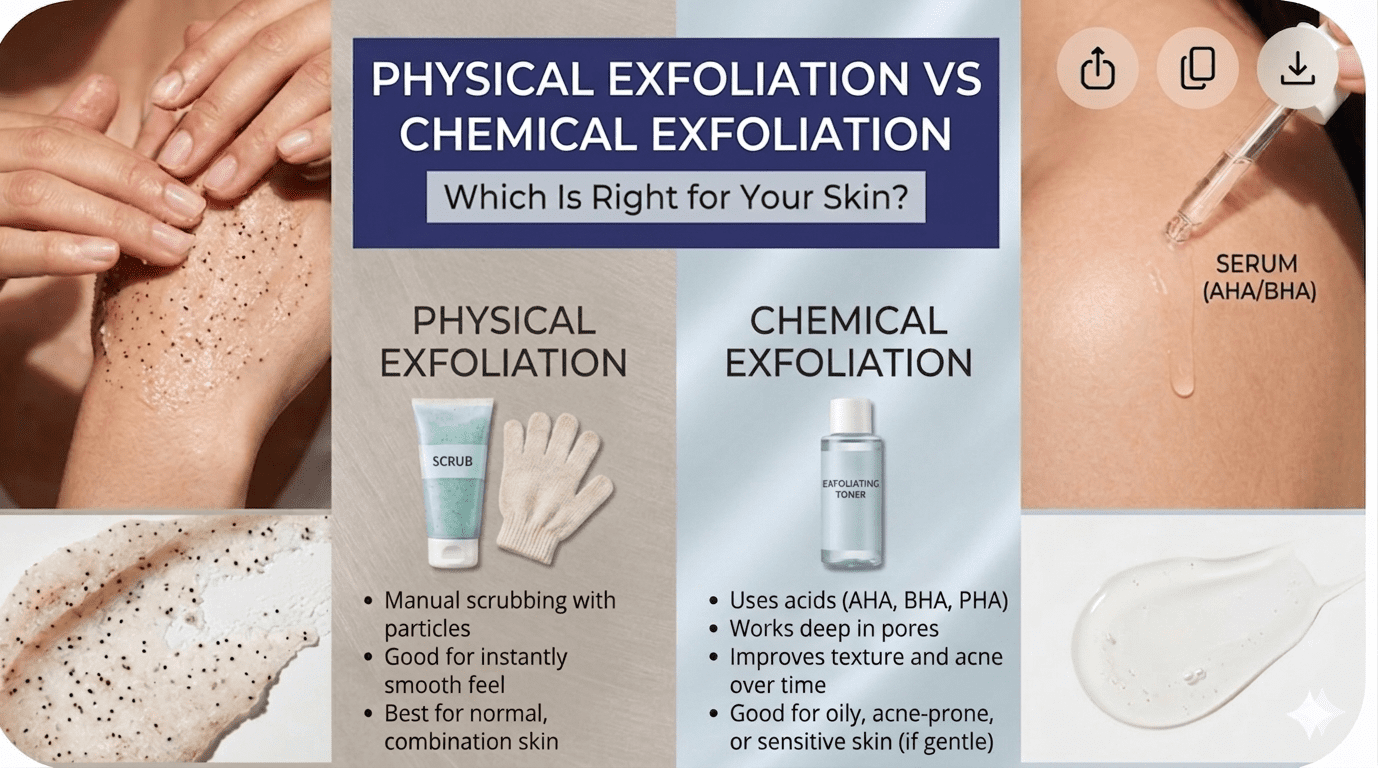
Physical exfoliation (also called mechanical or manual exfoliation) removes dead skin cells through direct, physical friction. An abrasive material, tool, or texture is applied to the skin and manually rubbed to dislodge dead cells from the surface.
Forms of Physical Exfoliants
Facial scrubs. Products containing small particles that provide abrasion when massaged onto the skin. Particle composition varies dramatically and is one of the most important quality indicators in physical exfoliants:
- Jagged, irregular particles (crushed walnut shell, apricot kernel, sugar crystals with sharp edges) have uneven edges that concentrate mechanical force unevenly, increasing the risk of microscopic skin lacerations. Dermatologists consistently flag this category as the most problematic.
- Spherical, uniform particles (jojoba beads, cellulose microbeads, finely ground rice bran) distribute pressure evenly across the skin surface, producing gentler and more controlled exfoliation. A 2023 study published in the Journal of Cosmetic Dermatology found that 68% of participants using walnut shell scrubs showed measurable stratum corneum disruption under confocal microscopy after a single use, compared to 12% of participants using spherical jojoba bead formulations. The difference came down to particle geometry, not natural vs synthetic origin.
Cleansing tools. Facial cloths, muslin cloths, silicone cleansing brushes, and konjac sponges provide mechanical exfoliation through texture and movement during cleansing. Generally gentler than scrubs, particularly when used with light pressure. Silicone tools with soft bristles are among the most consistently recommended physical tools by dermatologists because they allow controlled pressure and can be cleaned thoroughly between uses.
Exfoliating mitts and towels. Designed for body use. Fine-textured exfoliating mitts work well on areas with thicker, less reactive skin: upper arms, legs, back. Not appropriate for facial skin, which is thinner and more sensitive.
Microdermabrasion. A professional or at-home treatment that uses fine aluminium oxide crystals or a diamond tip to resurface the skin under controlled vacuum pressure. Significantly more regulated in its abrasion than consumer scrubs.
How Physical Exfoliation Works
The mechanism is direct: abrasive particles physically dislodge the outermost layer of dead skin cells through friction. The result is immediate: skin feels smoother immediately after use, rough patches are buffed away, and the surface is visibly more even.
Physical exfoliation works only on the cells accessible to friction at the skin’s surface. It cannot penetrate into pores, alter the bonds between cells below the surface, or address congestion at depth.
Advantages of Physical Exfoliation
- Immediate, tangible results: skin feels smooth right after use
- Simple to understand and apply, no pH considerations or absorption timing required
- Highly effective for body skin, particularly rough areas like knees, elbows, heels, and upper arms
- Accessible and inexpensive: many effective options require no specialist knowledge
- Does not increase photosensitivity (a relevant advantage for people who can’t use chemical exfoliants during the day)
- Useful for removing dry, flaky skin quickly before an event or treatment
Risks and Limitations of Physical Exfoliation
- Inconsistent exfoliation: results depend heavily on application pressure, time, and technique. Two uses of the same product can deliver very different levels of exfoliation depending on how hard you scrub.
- Micro-tears from jagged particles: irregular-edged abrasives can lacerate the skin’s surface at a microscopic level, causing inflammation, barrier disruption, and increased risk of bacteria entering compromised tissue
- Cannot address pore congestion: no physical scrub can penetrate the pore lining to dissolve the sebum and keratin build-up that causes blackheads and whiteheads
- Higher over-exfoliation risk for facial skin: the instinct to scrub harder for better results is counterproductive and can escalate barrier damage quickly
- Not suitable for active breakouts, rosacea, or inflamed skin: friction on inflamed or active acne can spread bacteria, worsen inflammation, and cause post-inflammatory hyperpigmentation
- Shorter-term results: physical exfoliation removes surface cells but does not address the rate of cell turnover or deeper skin function the way chemical exfoliation can
What Is Chemical Exfoliation?
Chemical exfoliation uses acids or enzymes to break the molecular bonds holding dead skin cells together, allowing them to shed naturally without physical friction. The process is invisible during application, there is no sensation of removal, but results accumulate over consistent use and can address skin concerns that physical exfoliation cannot reach.
Types of Chemical Exfoliants
AHAs (Alpha Hydroxy Acids). Water-soluble acids that work on the skin’s surface. They dissolve the desmosomal bonds connecting dead skin cells, allowing the outermost layer to shed more efficiently. The main AHAs in skincare:
- Glycolic acid: Smallest molecule, fastest penetration, most potent. Best for experienced users with resilient skin. Strong evidence for anti-ageing, brightening, and hyperpigmentation.
- Lactic acid: Larger molecule, slower penetration, gentler action. Also a humectant, so it hydrates as it exfoliates. The most appropriate AHA for dry, sensitive, or new-to-acids skin.
- Mandelic acid: Largest common AHA molecule. Penetrates most slowly, gentlest of the three. Anti-inflammatory and antibacterial properties make it suited to sensitive, acne-prone, and darker skin tones where glycolic acid risks triggering post-inflammatory hyperpigmentation.
- Malic and tartaric acid: Typically used as secondary AHAs to support primary actives rather than as standalone exfoliants.
AHAs are particularly effective for surface concerns: dullness, uneven tone, rough texture, fine lines, and hyperpigmentation. They increase photosensitivity and require daily SPF.
BHAs (Beta Hydroxy Acids). Oil-soluble acids, which is the key property that distinguishes them from AHAs. Because they dissolve in oil, BHAs can penetrate through sebum into the pore lining, where they dissolve the keratin plugs and sebum deposits responsible for blackheads, whiteheads, and recurring breakouts.
The primary BHA in skincare is salicylic acid, available over the counter at 0.5% to 2%. Beyond pore-clearing, it carries anti-inflammatory and antibacterial properties, making it the most clinically validated over-the-counter acne ingredient available. BHA is the clear choice for oily, congested, or acne-prone skin.
PHAs (Polyhydroxy Acids). A newer generation of chemical exfoliants with larger molecular structures than AHAs. Their slower penetration rate means significantly lower irritation potential, making them the gentlest class of chemical exfoliant available. PHAs also have humectant properties and antioxidant activity. The most common PHAs are gluconolactone and lactobionic acid. They are particularly suited to sensitive skin, rosacea-prone skin, and anyone who has had difficulty tolerating AHAs or BHA.
Enzyme Exfoliants. A distinct subcategory of chemical exfoliation that works through a different mechanism. Rather than using acids to break bonds via pH, enzyme exfoliants use proteolytic enzymes (primarily from fruit sources) to digest the keratin protein in dead skin cells.
The most commonly used enzymes are:
- Papain (from papaya): breaks down keratin proteins in dead cells; brightening and smoothing
- Bromelain (from pineapple): dissolves dead skin protein; has additional anti-inflammatory properties
- Pumpkin enzyme: rich in vitamins and antioxidants alongside its exfoliating action
Enzyme exfoliants work only at the skin’s surface, targeting loose dead cells without altering skin pH or penetrating into the follicle. They don’t stimulate the deeper cell turnover that AHAs and retinoids do, but their precision makes them exceptionally gentle. They do not increase photosensitivity to the same degree as acids, and some are stable enough for daytime use. For sensitive, reactive, or compromised skin that can’t tolerate acids, enzyme exfoliants are often the right entry point.
How Chemical Exfoliation Works
Chemical exfoliants break the molecular bonds (desmosomes) holding dead skin cells to the surface, allowing them to shed naturally. For AHAs, this happens via pH-dependent acid activity in the outermost skin layer. For BHA, the oil solubility allows it to work inside the pore. For enzymes, proteolytic activity targets the keratin protein specifically.
Unlike physical exfoliation, the process is independent of application pressure or technique. A consistent amount of exfoliation is delivered regardless of how gently or firmly the product is applied, making chemical exfoliation inherently more controlled.
Advantages of Chemical Exfoliation
- Consistent, measurable exfoliation regardless of technique or pressure
- BHA can reach inside the pore, addressing congestion that physical exfoliation cannot touch
- Long-term improvement in skin function, not just surface appearance: AHAs stimulate cell turnover and collagen production; BHA regulates sebum production over time
- Better clinical outcomes for hyperpigmentation, acne, fine lines, and texture than physical scrubs
- Lower risk of physical trauma to the skin’s surface when used at appropriate concentrations and frequency
- More suitable for acne-prone and inflamed skin than friction-based methods
- PHAs and enzyme exfoliants provide effective exfoliation for skin too sensitive for traditional acids
Risks and Limitations of Chemical Exfoliation
- Results are gradual, not immediate: skin doesn’t feel dramatically different on first use
- AHAs and BHAs increase photosensitivity, requiring daily broad spectrum SPF
- At high concentrations or overuse, chemical exfoliants can cause irritation, barrier disruption, peeling, and stinging
- Not suitable for compromised, broken, or severely reactive skin until the barrier has been restored
- Some skin conditions (very active eczema, open wounds, severe rosacea) are not appropriate for chemical exfoliation without professional guidance
- Product quality and formulation matter significantly: pH between 3 and 4 is required for AHAs and BHAs to be effective; poorly formulated products may underdeliver
Physical vs Chemical Exfoliation: Side-by-Side
| Physical Exfoliation | Chemical Exfoliation | |
|---|---|---|
| Mechanism | Friction removes surface dead cells | Acids or enzymes dissolve cell bonds |
| Immediate results | Yes (skin feels smoother instantly) | No (builds over consistent use) |
| Pore penetration | No | Yes (BHA only) |
| Consistency of exfoliation | Variable (depends on technique/pressure) | Consistent regardless of technique |
| Risk of micro-tears | Yes (jagged particles) | No |
| Increases photosensitivity | No | Yes (AHAs and BHAs; minimal with PHAs/enzymes) |
| Suitable for acne/active breakouts | No | Yes (BHA specifically) |
| Suitable for sensitive skin | With very gentle, spherical particles | PHAs and enzymes are preferred |
| Best use case | Body, immediate smoothing, lip exfoliation | Face, pore care, hyperpigmentation, anti-ageing |
| Risk level | Higher on face with harsh scrubs | Lower when concentration and frequency are appropriate |
Which Is Right for Your Skin?
Oily and Acne-Prone Skin
Chemical exfoliation with BHA (salicylic acid) is the clear recommendation. No physical exfoliant can reach inside the pore to dissolve sebum and keratin build-up. Salicylic acid’s oil-solubility, anti-inflammatory properties, and antibacterial action make it the most evidence-backed choice for this skin type. Physical scrubs on acne-prone skin risk spreading bacteria and worsening inflammation through friction.
Dry and Dehydrated Skin
Chemical exfoliation with lactic acid is best suited here. Its dual role as both an exfoliant and a humectant improves texture while hydrating simultaneously. Physical scrubs on dry skin risk over-stripping an already compromised barrier. If chemical acids feel too intense initially, enzyme exfoliants are the gentlest entry point.
Sensitive or Reactive Skin
PHAs or enzyme exfoliants are the most appropriate starting point. Their gentler mechanism and larger molecular size mean significantly less irritation risk than AHAs or BHAs. Physical scrubs on sensitive skin, particularly those with irregular particles, are generally contraindicated. Silicone cleansing tools with very light pressure are the only physical method worth considering, and even then, infrequently.
Hyperpigmentation and Uneven Skin Tone
Chemical exfoliation with AHAs (glycolic or mandelic acid depending on sensitivity level) addresses pigmentation directly by accelerating the shedding of pigmented surface cells and, in glycolic acid’s case, by directly inhibiting melanin production. Physical exfoliation removes surface cells but doesn’t target the melanin production process. For darker skin tones, mandelic acid is often recommended over glycolic acid to reduce the risk of triggering post-inflammatory hyperpigmentation through irritation.
Dull Skin and Rough Texture
Both can improve surface texture, but chemical exfoliants deliver more consistent results over time. A well-formulated AHA toner or serum used two to three times per week will produce steadier improvement than a scrub used with variable pressure.
Body Skin
Physical exfoliation is highly effective for the body, particularly on rough areas such as knees, elbows, heels, and keratosis pilaris-prone upper arms. Body skin is thicker and less reactive than facial skin, making it more tolerant of friction. Chemical exfoliants work on body skin too (lactic acid body lotions are excellent for keratosis pilaris), but physical exfoliation is more practical and often sufficient for general body smoothing.
Mature Skin
Chemical exfoliation is generally preferred. Mature skin is often thinner and more fragile, making it more susceptible to barrier disruption from friction. Glycolic or lactic acid supports cell turnover and collagen production in a way physical exfoliation cannot. If a physical method is desired, only the gentlest tools (soft konjac sponge or muslin cloth) with minimal pressure are appropriate.
Signs You Are Over-Exfoliating
Over-exfoliation is one of the most common and most underrecognised skincare mistakes, and it looks the same whether you’ve pushed too hard with a scrub or used too high a concentration of acid too often.
Warning signs:
- Skin that feels tight, raw, or stings after washing with a gentle cleanser
- Redness or a burning sensation when applying previously well-tolerated products
- Increased breakouts, particularly small, uniform bumps across the forehead or cheeks
- Shiny, waxy-looking skin that seems paradoxically oilier despite exfoliation
- Persistent flaking that doesn’t improve despite moisturising
- Heightened sensitivity to environmental factors: wind, heat, air conditioning
If you notice these signs, stop all exfoliation immediately. Rebuild the barrier with a gentle cleanser, a ceramide-rich moisturiser, and SPF. Wait until skin is fully settled before reintroducing exfoliation, starting at the lowest frequency and concentration.
How to Introduce Exfoliation Safely
For chemical exfoliants: Start with a lower concentration (5% AHA or 0.5% to 1% BHA) once or twice a week in the evening. Allow two to four weeks at this frequency before increasing. Apply to clean skin before serums and moisturiser. Follow every morning with broad spectrum SPF.
For physical exfoliants (face): Use only spherical-particle products or soft tools. Apply with minimal pressure, using small circular motions for no more than 30 to 60 seconds. Rinse thoroughly with lukewarm water. Follow immediately with a hydrating moisturiser. Limit to once or twice per week at most.
For physical exfoliants (body): More frequent use is generally tolerable. Two to three times per week on dry or rough areas is appropriate for most people. Avoid freshly shaved or irritated skin.
In both cases: never exfoliate compromised, sunburned, or broken skin. Patch test any new product on a small area before applying it across the face.
Common Questions
Is chemical exfoliation better than physical for the face? In most cases, yes. Chemical exfoliation provides more consistent, controlled results, can address pore congestion (BHA), and doesn’t carry the risk of mechanical trauma to the skin. For facial use, dermatologists widely prefer well-formulated chemical exfoliants over scrubs.
Can I use a face scrub every day? Not recommended, particularly on the face. Daily physical exfoliation removes too many surface layers too quickly, disrupting the barrier and causing the inflammation, sensitivity, and paradoxical dullness associated with over-exfoliation. Two to three times per week is the upper limit for most facial exfoliation, physical or chemical.
Are natural scrub particles safer than synthetic ones? No. The safety of a physical exfoliant is determined by particle shape and size, not whether it’s naturally derived. Crushed walnut shell and apricot kernel are natural but have irregular, jagged edges that concentrate mechanical force unevenly. Spherical synthetic beads or jojoba beads distribute pressure evenly and are significantly safer.
Can I use a chemical exfoliant during the day? AHAs and BHAs increase photosensitivity and are most safely used in the evening, with SPF applied every morning. PHAs and enzyme exfoliants are more photostable and better suited to daytime use, though SPF remains essential regardless.
What should I do if chemical exfoliation stings or burns? A mild tingling on application is common and expected, particularly with AHAs. Pronounced stinging, burning, or prolonged redness is a signal that the concentration is too high, the frequency is too great, or your skin barrier is already compromised. Reduce concentration and frequency, support the barrier with ceramide-rich products, and allow the skin to recover before continuing.
The Bottom Line
Physical and chemical exfoliation are not interchangeable. They work differently, deliver different results, and suit different skin types.
Physical exfoliation delivers instant smoothness through friction, works well on body skin, and is effective for surface-level texture when gentle, spherical-particle products are used with light pressure. On the face, particularly for sensitive, acne-prone, or congested skin, it carries significant risk of mechanical trauma and fails to address the pore-level concerns that chemical exfoliants target.
Chemical exfoliation delivers more consistent, measurable results over time, can penetrate into pores (BHA), addresses surface concerns more thoroughly (AHA), and suits a wider range of facial skin types and concerns when used at appropriate concentrations and frequencies. It requires slightly more care around photosensitivity and introduction pace, but delivers superior clinical outcomes for most common skin concerns.
For most people with facial skin concerns, chemical exfoliation is the stronger long-term choice. For the body, physical exfoliation is practical and effective. And for skin that doesn’t tolerate either well, enzyme exfoliants and PHAs offer a gentler middle ground that should always be explored before abandoning exfoliation altogether.
Start gentle, build slowly, and let your skin guide the pace.


